Introduction to Foreign Exchange
Real-time foreign exchange pricing and trade execution
What is the Foreign Exchange (FX) API?
The FX API enables businesses to access real-time foreign exchange (FX) pricing and execute FX trades directly within their own treasury, ERP and operational platforms.
The API supports both the request and acceptance of FX quotes, allowing clients to manage FX execution seamlessly without needing to log into CommBiz IPFX to manage each transaction. All executed trades remain visible within CommBiz IPFX, ensuring a consolidated view of FX activity.
Key Features & Benefits
By embedding FX pricing and execution into their existing systems, businesses can eliminate manual re-entry of trade details, reduce duplication and enable faster, more efficient FX transactions.
For Businesses
- Access real-time, competitive FX pricing directly within existing treasury systems
- Eliminate manual data re-entry and reduce operational duplication
- Lock in FX rates instantly to protect against market fluctuations
- Enable faster, automated FX execution and straight-through processing
- Seamlessly integrate into existing treasury, ERP or payment workflows
- Improve operational efficiency and reduce error risk
How Does the FX API Work?
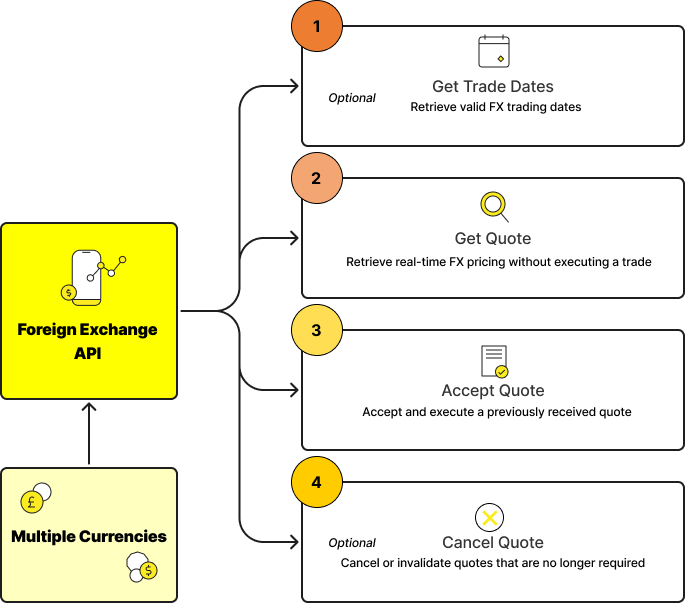
The FX API is a flexible FX integration offering comprising four endpoints that support FX pricing, trade execution, quote lifecycle management and trade date handling8 that enable businesses to embed FX capabilities directly into their systems and workflows.
The FX API has four key capabilities: clients can integrate individual APIs based on their specific requirements or combine them to support fully automated, end-to-end FX workflows.
| API Function | Description |
|---|---|
| GetQuote | Requests a real-time FX quote, providing accurate and competitive rates across currency pairs |
| AcceptQuote | Accepts and locks in a quoted FX rate, protecting against market movements and ensuring pricing certainty |
| GetTradeDates | Retrieves available trade dates |
| CancelQuote | Cancels or invalidates an existing FX quote that is no longer required or has not been executed |
Who can use the FX API?
The FX API is designed for businesses that need real-time FX pricing, automated trade execution and embedded FX capabilities within operational or customer-facing workflows.
| Business Type | Typical Use Cases |
|---|---|
| Enterprises & Treasury Functions | Managing FX exposure, hedging and automating high-volume FX workflows |
| Payment Providers & Fintechs | Embedding FX conversion into payment journeys and enabling cross-border transactions |
| Marketplaces & Platforms | Supporting multi-currency buyer/seller ecosystems and automated currency conversion |
| Asset Managers & Institutional Clients | Executing large FX volumes and integrating FX into investment workflows |
| E-commerce & Global Merchants | Displaying local currency pricing and managing international settlement flows |
| Global Payroll & Operations Teams | Managing overseas payroll, supplier payments and treasury funding requirements |
Where can the FX API be integrated?
The FX API is designed to integrate flexibly into existing business systems and workflows, enabling FX pricing and execution to occur directly within the platforms businesses already use to manage payments, treasury and operations.
| System Type | Example Use Cases |
|---|---|
| Treasury Management Systems (TMS) | FX exposure management, hedging, liquidity management |
| Enterprise Resource Planning (ERP) & Finance Systems | Supplier payments, invoice settlement, reconciliation |
| Payment Platforms | Cross-border payments and automated currency conversion |
| Marketplaces & Platforms | Buyer/seller currency conversion and multi-currency settlement |
| E-commerce Platforms | Real-time FX pricing and checkout conversion |
| Risk & Trading Systems | Pricing feeds, risk monitoring and execution workflows |
| Back-office & Operational Systems | Straight-through processing and automated trade workflows |
User Journeys
The FX API supports a range of FX workflows depending on the level of pricing, execution and lifecycle management required. Clients can integrate individual endpoints based on their specific operational needs, or combine endpoints to support fully automated, end-to-end FX workflows.
GetQuote | For Pricing & Rate Discovery
Retrieves a real-time executable or indicative FX quote without executing a trade.
GetQuote & AcceptQuote | For End-to-End FX Execution
Retrieves a live FX quote and immediately executes the trade within a single workflow..
GetTradeDates | For Trade Date & Forward FX Management
Retrieves available trade dates and associated FX pricing information for date-specific FX transactions.
CancelQuote | For Quote Lifecycle Management
Cancels an FX quote that is no longer required or will not be executed.
FX API Use Cases
The following table outlines the primary FX API workflows, their purpose and common business use cases.
| API / Workflow | Primary Purpose | Typical Use Cases | Business Example |
|---|---|---|---|
| GetQuote | Retrieve real-time FX pricing without executing a trade | Rate discovery, pricing display, treasury analytics, pre-trade validation | An e-commerce platform displays live converted pricing at checkout |
| GetQuote + AcceptQuote | Retrieve and immediately execute FX trades within a single workflow | Real-time trading, embedded FX, automated payments, dynamic hedging | A business locks an FX rate while paying an overseas supplier |
| GetTradeDates | Retrieve valid FX trading dates | Retrieve tradeable, non-tradeable, and first available settlement dates for a currency pair | A treasury team retrieves the next available date for settlement for a currency pair, taking into account cut-offs and holidays |
| CancelQuote | Cancel or invalidate quotes that are no longer required | Abandoned transactions, quote replacement, workflow timeouts | A quote is cancelled after a payment workflow is abandoned |
FX API Workflow
The diagram below illustrates how the FX APIs can be combined to support pricing, execution and quote lifecycle management workflows.